

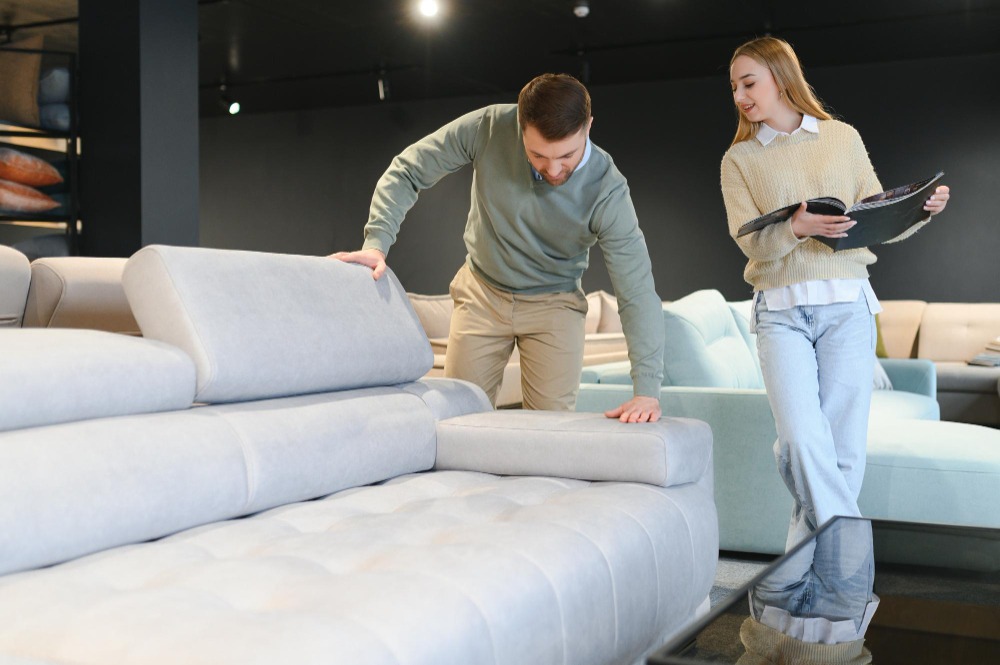
A Customised Sofa allows the furniture to be designed around a room rather than requiring the room to adapt to standard dimensions. Buyers can define the size, configuration, seating characteristics, upholstery, arm profile, and other visual details.
The key to successful custom manufacturing is finalising important specifications before production begins.
Confirm Exact Measurements
Begin with the total available floor area.
Confirm the proposed sofa width, depth, height, seat depth, seat height, arm width, and sectional dimensions where relevant.
Marking the proposed footprint on the floor can help you understand how much room will remain for movement.
Do not forget nearby tables, doors, windows, and other furniture.
Check the Delivery Route
The sofa needs to reach its final position.
Measure the main entrance, internal doorways, staircase, lift opening, corridors, and any tight turns.
This becomes especially important for large sectional sofas.
Where access is restricted, modular construction may need to be considered during the design stage rather than after production.
Define How You Want to Sit
Explain the intended usage clearly.
A formal sofa may require a more upright posture. Family television seating may benefit from deeper proportions. A lounge area may prioritise relaxed seating.
Specify preferences regarding cushion softness, back height, seat depth, armrests, and overall support.
Reference images are useful for appearance but do not fully communicate comfort.
Choose Upholstery Carefully
Do not select fabric solely from a digital photograph.
Where possible, evaluate the texture and colour through suitable samples.
Consider cleaning requirements and the expected level of daily use.
Homes with children, pets, or frequent guests may have different upholstery priorities from formal sitting rooms.
Finalise Functional Details
Clarify smaller features before manufacturing.
These may include:
- Fixed cushions
- Loose cushions
- Removable covers
- Chaise position
- Leg style
- Arm profile
- Base design
- Storage where applicable
- Decorative stitching
- Sectional arrangement
For an L-shaped design, make sure the orientation is clearly understood.
Coordinate the Design With the Interior
Consider flooring, curtains, wall finishes, lighting, rugs, tables, and other furniture.
The sofa does not need to match every element exactly.
Instead, aim for a balanced relationship between colour, texture, scale, and overall design character.
Keep a Final Specification
Custom furniture involves multiple decisions.
A written specification helps keep dimensions, upholstery, configuration, materials, and selected design details clear.
Craftsmen Ventures manufactures customised furniture based on individual space requirements and defined specifications.
A successful customised sofa should solve practical problems as well as achieve the desired appearance. Accurate measurements, clear comfort preferences, suitable upholstery, delivery planning, documented specifications, and thoughtful proportions can significantly improve the final result.